Predictable B2B Pipeline to grow without relying on campaign spikes

If your B2B pipeline rises and falls like a roller coaster, it’s rarely “bad luck.” Most of the time, it’s a system issue: too much dependence on one-off initiatives, limited visibility into early buying signals, and a marketing-to-sales handoff that isn’t standardized. For B2B decision-makers, this creates three very real problems: unreliable forecasting, opportunity cost (sales teams chasing noise), and growth that’s hard to sustain.
This article takes a MOFU/BOFU angle: a pipeline approach that prioritizes accounts and leads with real intent, aligns marketing and sales with simple operating rules, and creates a continuous improvement loop so pipeline stops being “an outcome” and becomes a managed asset.
Why your B2B pipeline isn’t predictable
Most B2B pipelines become unpredictable due to a mix of these factors:
Too much demand creation and not enough demand capture
When pipeline relies almost entirely on paid, events, or isolated campaigns, any budget shift or seasonality hits opportunities directly. Captured demand (SEO, intent-led content, comparisons, case studies) takes longer to mature, but it stabilizes outcomes over time.
Decision signals mixed with interest signals
Downloads, email opens, or one-off visits can reflect curiosity, not a buying decision. If your scoring or prioritization doesn’t separate true intent, you get lots of activity but little progression.
No standardized handoff to sales
If marketing “hands over leads” and sales decides what’s worth working “by feel,” the system breaks. Without a standard—what gets accepted, how fast it’s followed up, and why it gets rejected—pipeline becomes subjective and difficult to optimize.
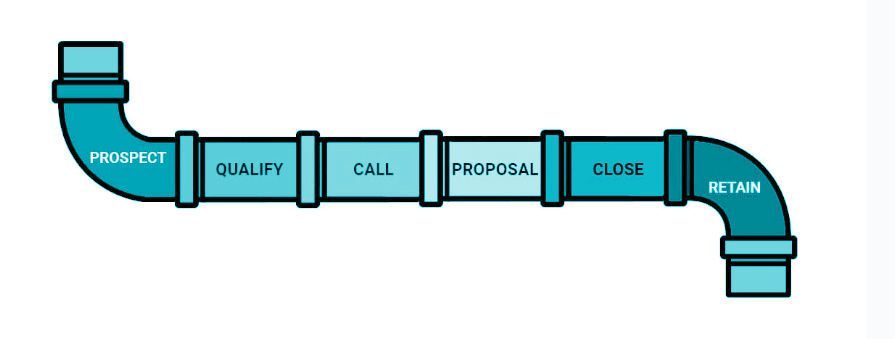
The predictable B2B pipeline model in three layers
The most practical way to stabilize pipeline is to design it as a system with three reinforcing layers.
Layer 1: capture demand with intent
The goal here is to attract buyers who are already close to evaluating vendors. In B2B, the assets that tend to move the needle include:
- solution pages by use case and industry
- comparisons and alternatives
- case studies with operational context
- security, compliance, and integrations content
- “how-to” pieces built for decision-making, not general education
This layer doesn’t just generate traffic—it generates signals, and those signals enable better prioritization.
Layer 2: create demand to open target accounts
Demand creation (ABM, paid, social, email) performs best when it’s tied to a clear hypothesis: “this account has fit and intent, we need to unblock a specific objection.” It’s not about impressions—it’s about movement.
In a healthy B2B pipeline, demand creation does two things:
- increases the number of in-market accounts that actively consider you
- accelerates latent opportunities by reducing friction and shortening stages
Layer 3: commercial activation with rules and speed
This layer turns signals into meetings, and meetings into opportunities. The standard here isn’t “call more.” It’s “act faster and act better.”
Three principles:
- fast response when intent is present
- messaging aligned to role and objection
- an accept/reject system with a stated reason so you can learn
When this layer works, pipeline becomes predictable because it stops depending on individual judgment and starts depending on operating rules.
What to measure so pipeline becomes manageable
A B2B pipeline becomes predictable when you measure stage progression, not just volume. In practice, there are three metric groups leadership cares about.
Input quality metrics
- the percentage of leads or accounts that match your ICP
- sales acceptance rate and rejection reasons
- conversion rate from intent signals to meetings
The underlying question is: “Are we feeding the pipeline with the right inputs?”
Progression metrics
- stage velocity (days spent in each stage)
- stage-to-stage conversion rates
- number of roles involved in enterprise accounts
The underlying question is: “Is our pipeline moving—or stalling?”
Outcome metrics
- opportunities created and weighted value
- win rate and sales cycle length
- marketing-influenced pipeline within target accounts
The underlying question is: “Does this system create revenue repeatedly?”
The critical point most teams don’t standardize
If there’s one lever that reduces friction between teams and improves pipeline predictability, it’s having a formal acceptance step between marketing and sales.
You don’t need a specific label. What matters is a moment where sales decides:
- accept as “workable”
- reject—and state why
This turns pipeline into a learning loop. If most rejections are “not ICP,” the issue is targeting. If rejections are “no intent,” your signals are wrong. If rejections are “not now,” you need better nurturing and trigger-based follow-up.
How to apply this in 30 days without paralyzing teams
A common mistake is trying to redesign everything at once. If your goal is a more predictable B2B pipeline, focus on what moves the needle within a month:
Week 1: ICP clarity and intent signals
Define which accounts you want—and which you don’t. List 5–7 signals that, in your business, most closely resemble real evaluation.
Week 2: decision-stage assets
Strengthen or create assets that resolve common objections: comparisons, case studies, security, integrations, and “how implementation works.” You don’t need 20 pieces—you need 4–6 excellent ones.
Week 3: handoff standard and speed
Define when a lead/account is routed to sales, the response SLA, and a short set of allowed rejection reasons. Make feedback easy to record.
Week 4: executive review and adjustments
Review acceptance, rejection reasons, and conversions. Adjust signals and prioritization. At this point you should see less noise and more focus.
If you want to accelerate implementation with a proven operating model, Sheridan can help you define signals, build decision assets, and align the process without turning it into a never-ending project.
Common mistakes that make pipeline unpredictable
- confusing activity with intent and rewarding what’s easy to generate
- measuring “leads” as success without tracking acceptance and progression
- lacking BOFU assets that resolve real objections
- moving too slowly when intent is clear
- not reviewing rejection reasons and refining the system
Conclusion
A predictable B2B pipeline isn’t built by chasing more volume. It’s built with a system that combines intent capture, demand creation for target accounts, and a rules-based commercial activation layer. When you align signals, assets, and process, forecasting improves, sales regains focus, and pipeline stops depending on campaign spikes. If your priority is stable opportunity flow and leadership-level accountability, this is the kind of approach that turns pipeline into a competitive advantage.
Request your free consultation with our experts right here.
Frequently asked questions