Modern B2B lead scoring: from MQL to PQL and real sales alignment

Classifying “high-value” leads should accelerate pipeline, not create ongoing friction between marketing and sales. Yet in many B2B organizations, B2B lead scoring still relies on superficial signals—clicks, downloads, one-off visits—that generate volume but not meaningful sales conversations. The outcome is familiar: sales loses confidence in inbound leads, while marketing feels that “no one follows up” on what’s being handed over.
The most practical evolution in 2026 is to move from an MQL-centered scoring model to one that incorporates buying intent and, when there is a product, signals of experienced value to activate PQLs. This approach doesn’t just prioritize better; it also creates a shared language across teams.
Why traditional MQL is no longer enough
Classic MQL scoring is built by combining ICP fit and content engagement: role, industry, and company size, plus downloads, webinars, or email opens. It’s a useful model to organize the top of the funnel, but it fails when it’s treated as a “passport” to sales.
The reason is simple: consuming content doesn’t always mean someone is ready to buy. As the document summarizes clearly, a large share of traditional MQLs don’t convert because informational interest is not the same as commercial intent. In B2B—where buying committees, long cycles, and multiple motivations are the norm—that gap becomes even larger.
If your pain point is “we have plenty of leads, but not many good ones,” the issue is usually that scoring rewards easy-to-generate activity and underweights signals that are harder to earn but far more predictive.
What a PQL is and why it changes pipeline quality
A PQL is based on something different: not on what a lead says or reads, but on the value they demonstrate inside the product. This approach is especially powerful in freemium and free-trial models, where you can observe actions that correlate with adoption and, therefore, with purchase.
A PQL is triggered when the user reaches concrete milestones: inviting teammates, exceeding usage thresholds, or configuring key integrations. These actions often indicate the lead has found a real use case and is building operational dependence—exactly what a B2B decision-maker wants to see before committing budget.
The strategic implication is significant: B2B lead scoring stops being a “temperature check” for interest and becomes a predictor of intent backed by evidence.
The layers of modern B2B lead scoring
A strong system doesn’t stand on a single signal. It stands on layers that together tell a coherent story: fit, intent, and evidence.
Fit with the ICP
Fit answers a leadership-level question: “even if they buy, is this the customer we want?” This includes size, industry, geography, digital maturity, and commercial viability variables. This layer is your guardrail: it prevents a highly active lead from rising to the top if they don’t actually match your offer or your margin structure.
In practice, many B2B companies set a minimum fit threshold so the rest of the signals have meaning. Without that filter, scoring becomes a machine for prioritizing curiosity.
High-intent behavior and engagement
Intent isn’t measured by “a lot of traffic,” but by signals close to a decision. The document highlights the weight of high-intent pages such as pricing, as well as visit frequency and behavior across key assets. In B2B, the following often matter as well:
- comparison and alternatives pages
- industry-specific case studies
- security and compliance content
- implementation, integrations, or migration pages
- repeated visits within short time windows
The difference between mediocre scoring and useful scoring is often here: separating exploratory consumption from evaluative behavior.
Product signals that activate PQL
When you have a measurable product, this layer typically correlates best with revenue. The document presents it as the strongest sales trigger when real product usage is integrated.
What matters less is “how much” the user does, and more “what” they do. The most effective recommendation is to define one or two events that represent the moment when value becomes tangible, and use them as triggers for commercial prioritization. In B2B, it’s also important to shift focus from the individual to the account: team invites, multi-user setup, permissions, and integrations with core systems.
Predictive prioritization with AI
The document describes a fourth layer where algorithms adjust scores in real time and identify complex patterns such as interaction speed or buying-group behavior. This can add substantial value, but there’s a condition in B2B environments: prioritization must be explainable. If sales doesn’t understand why a lead is at the top, internal adoption drops.
A strong implementation uses AI to refine weights and detect meaningful combinations of signals, while maintaining a clear interpretive framework for the commercial team.
The step that prevents conflict: SAL as an operating standard
One of the most useful changes in mature B2B organizations is formalizing SAL. The document presents it as the bridge: marketing identifies MQL or PQL, sales accepts the lead as valid after a quick validation, and only then does it become an SQL when real need, authority, and timing are confirmed.
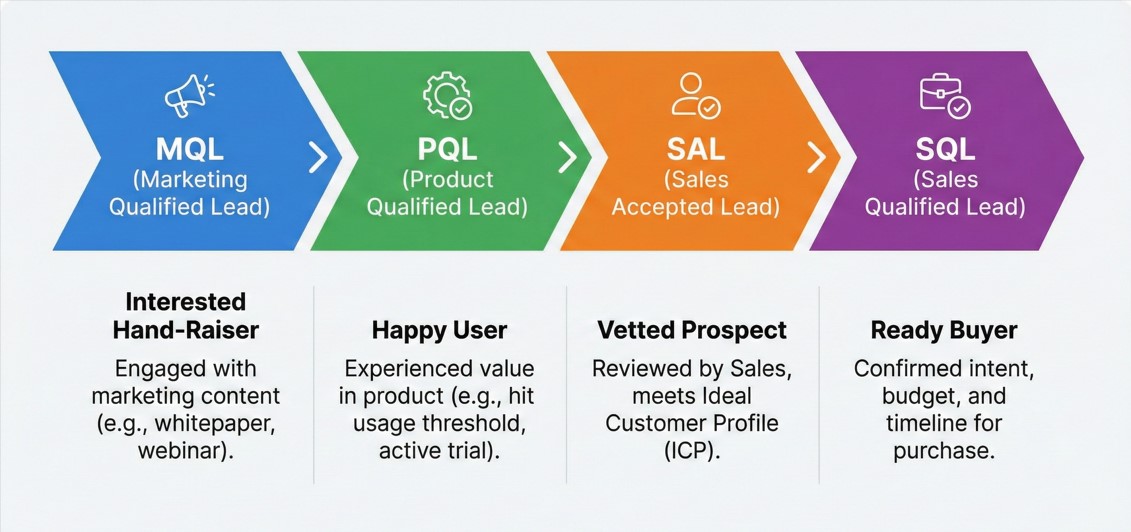
This solves a classic issue: without an intermediate state, marketing measures “delivered” and sales measures “useful,” but nobody measures the point where the lead is accepted or rejected with a reason. SAL enforces discipline:
- sales must accept or reject with feedback
- marketing adjusts scoring using real evidence
- leadership gains visibility into the handoff and its bottlenecks
For decision-makers, SAL isn’t bureaucracy—it’s pipeline quality control.
Current frameworks to qualify without slowing commercial execution
BANT still exists, but in digital B2B environments, frameworks that prioritize intent and observable signals often work better. The document highlights AIQ, FASTER, and MQAs.
- AIQ helps prioritize quickly when funnel volume is high and you need to decide who to call first.
- FASTER expands analysis for more complex scenarios, where fit and timing matter as much as activity.
- MQAs fits especially well in ABM, because it reflects the B2B reality: accounts buy, not individual leads.
The goal isn’t choosing the trendiest framework, but standardizing one that sales can use without friction and marketing can fuel with consistent signals.
How to implement a model without paralyzing teams
If your goal is to classify high-value leads reliably, implementation should prioritize speed of learning over perfection:
- define a realistic ICP and exclusion criteria
- identify high-intent signals specific to your buying process
- set one or two PQL events if you have instrumented product usage
- formalize SAL with mandatory acceptance or rejection
- review the model regularly using conversion data and sales feedback
This approach reduces subjective debate and replaces it with continuous improvement.
Typical mistakes that inflate volume and reduce quality
- rewarding easy-to-generate actions that correlate weakly with purchase
- scoring individuals instead of accounts, ignoring the buying group
- sending leads to sales without formal acceptance or a rejection reason
- failing to review weights when campaigns, product, or value proposition change
- relying on AI without clear rules for explanation and governance
Conclusion
A B2B lead scoring model that works isn’t chasing “more leads”—it’s chasing better sales conversations. The shift from MQL to PQL, the use of high-intent signals, and the formalization of SAL create a system where marketing and sales share criteria and learn from real data. If your team struggles to classify high-value leads today, the fastest path isn’t adding more points to the score—it’s redesigning which signals represent a decision and which represent simple consumption.
Request your free consultation with our experts right here.
Frequently asked questions