
When CAC rises, acquisition becomes more expensive, and pipeline turns more volatile, expanding within existing customers stops being a “nice to have” and becomes a strategic lever. The problem is that many B2B companies run cross-sell and upsell as isolated actions (a campaign, an email, a call) and get frustrated: the timing is off, the message reaches the wrong role, or Customer Success and Sales operate in silos.
The alternative is to treat B2B account expansion as a system: signals → triggers → campaigns → commercial conversation → adoption → renewal. This article gives you a MOFU/BOFU playbook to build it with discipline, without fluff, and with metrics an executive team will recognize.
Why B2B account expansion becomes critical when CAC spikes
In B2B environments, increasing budget to “compensate” for higher CAC often makes the problem worse: more spend to capture colder demand, longer cycles, and more pressure on teams. Expansion is different because it starts with a real advantage: an existing relationship, shared context, and proven value.
What usually blocks expansion isn’t lack of “offer,” but three recurring frictions:
- There is no clear map of incremental value: which module, service, or higher plan solves which problem—and for whom.
- The moment isn’t detected: you try to sell “more” before the customer has consolidated value.
- There is no coordination: CS optimizes health and adoption; Sales optimizes revenue; Marketing optimizes activity—and no one orchestrates the system.
Cross-sell and upsell in B2B: the difference that matters for expansion
Generalist articles define concepts and examples, but in B2B what matters is how this translates into buying committees, risk, and adoption.
- Cross-sell in B2B means expanding the scope inside the account with complementary capabilities (modules, integrations, services, support, training). Buyers perceive it as “closing gaps” or “avoiding auxiliary tools.”
- Upsell in B2B means upgrading plan, scope, or coverage (more users, stronger security, higher SLAs, more automation). Buyers perceive it as “reducing risk” or “scaling operations.”
The key: in B2B you’re not selling “more.” You’re selling less friction, less risk, or more operational impact.
The B2B account expansion system in 4 pillars
Pillar 1: account segmentation built for expansion
Not every account has the same potential. Segment using three simple variables:
- Potential: size, structure, multi-team footprint, usage complexity, number of use cases.
- Maturity: current adoption, stabilized processes, active champions, internal roadmap.
- Risk: churn signals, critical tickets, low activation, price pressure.
This prevents two costly mistakes: trying to expand accounts that are “at risk” (without fixing the basics) and missing the timing in accounts that are ready to scale.
Pillar 2: an incremental value map
If your expansion message is “we have a new module,” nothing moves. Define a map like this: problem → capability → outcome → proof.
Example structure (applies to SaaS, services, or hybrid models):
- Problem: “we depend on manual processes and inconsistent reporting”
- Capability: “automation + advanced reporting + roles/permissions”
- Outcome: “fewer hours, more control, faster decisions”
- Proof: “case study, benchmark, before/after, demo guided by their process”
That turns expansion into a reasonable decision—not an opportunistic sale.
Pillar 3: triggers that activate expansion
This is the difference between “campaigns” and a “system.” Triggers can be usage-based, relationship-based, or business-based. In B2B, they work best when they combine signal + context.
Usage triggers (product/service):
- sustained growth in active users or teams
- adoption of key features (value is already consolidated)
- recurring use of a feature that naturally “asks” for the next (a natural limit)
- need for integrations or governance (roles, permissions, auditing)
Relationship triggers (Customer Success):
- high NPS or strong qualitative feedback
- an active champion sharing results internally
- renewal approaching with good health (a moment to reframe value)
Business triggers (account):
- growth, hiring, new sites/business units
- regulatory or compliance changes
- new strategic goals (new line of business, international expansion)
Golden rule: the trigger is not “we can sell.” It’s “it makes sense for them to buy now.”
Pillar 4: orchestration across Customer Marketing, CS, and Sales
If expansion depends on a single sales call, it will be inconsistent. The winning playbook distributes roles:
- Customer Marketing activates education, case studies, internal comparisons, exclusive events, and use-case emails.
- Customer Success validates timing, identifies objections and champions, and ensures adoption so you’re not “selling on sand.”
- Sales/Account Management converts momentum into proposal, negotiation, and close.
Without orchestration, decision-makers feel it: inconsistent messages, offers out of timing, and unnecessary friction.

A phased playbook to execute B2B account expansion
Phase 1: identify “ready” accounts and “at-risk” accounts
Goal: prioritize focus.
- build a simple score: Potential (1–5) + Maturity (1–5) − Risk (1–5)
- classify 30–50 accounts into three groups: Expand now / Prepare / Recover
Phase 2: build a role-based narrative
Expansion decisions typically involve:
- sponsor: ROI, risk, impact
- lead user: adoption, operations, “this makes my work easier”
- IT/security: control, integrations, compliance
- procurement: predictability, terms, scaling
Prepare one message per role that answers:
- what changes if they expand
- what risk is reduced
- what evidence supports it
- what the low-risk next step is
Phase 3: Customer Marketing campaigns that open conversations
You’re not chasing clicks. You’re chasing signals and conversations. BOFU formats that work:
- one-page mini case studies by industry
- a “maturity roadmap” (where they are vs where they could be)
- compliance/security guides where relevant
- closed customer webinars (not generic) with real examples
- trigger-based email sequences (not newsletters)
Phase 4: a commercial conversation with a phased proposal
In B2B, “upgrade to the higher plan” can create resistance if it feels like a big jump. Propose expansion that scales:
- phase 1: controlled pilot (team/area)
- phase 2: rollout to additional business units
- phase 3: standardization and optimization
This reduces perceived risk and speeds up approval.
Phase 5: ensure adoption and protect renewal
Expansion that isn’t adopted becomes delayed churn. Close the loop:
- an adoption plan with milestones
- a definition of “value achieved” (which metrics matter to the customer)
- an executive review (QBR) with results and next steps
Which metrics to use to measure expansion without fooling yourself
For decision-makers, expansion must show up in revenue and health metrics:
- Net Revenue Retention and/or expansion revenue
- percentage of accounts with expansion vs total base
- average time from trigger to conversation and close
- post-expansion adoption rate (prevents “sold but unused”)
- win rate of expansion proposals by segment
If you only measure “campaigns sent” or “emails opened,” you lose control of the system.
Recommended lead magnet to capture leads
If you want to turn this approach into demand generation for Sheridan, the most useful lead magnet is:
- Account Expansion Plan (template)
- Trigger and campaign model (by signal type and role)
The BOFU offer is clear: “we help you design your expansion system using your real signals, your stack, and your CS/Sales structure.”
Conclusion
When CAC rises, expansion stops being a tactic and becomes strategy. Sustainable B2B growth happens when you turn cross-sell and upsell into a system based on signals, timing, and real coordination between Customer Marketing, CS, and Sales. If you’re seeing stagnation or pressure from acquisition, the fastest path to predictability is often within your existing accounts: with the right playbook, expansion becomes measurable, repeatable, and defensible at leadership level.
If you want to turn B2B account expansion into a reliable growth lever instead of relying on ever-rising CAC, Sheridan can help you build a measurable expansion plan with the right triggers, campaigns, and alignment across Customer Marketing, CS, and Sales. Get in touch with us and we’ll map it to your specific accounts and revenue goals.
Frequently asked questions
AI is already part of the B2B marketing stack, but the hardest conversation isn’t “which tool are we using?” It’s how we prove it generates real value. If the leadership team only sees outputs (“we produced more assets,” “we automated campaigns”), AI investment is perceived as discretionary spend. To justify it, you need to translate AI into business outcomes: efficiency, conversion, pipeline, and predictability.
This post gives you a framework to measure AI ROI in B2B marketing with rigour—without falling into vanity metrics—and with arguments a CEO/CFO will understand.
Why measuring AI in B2B is different from measuring automation
In B2B, impact is rarely linear. Buying decisions involve committees, cycles are long, and “last click” almost never tells the full story. This creates two common traps or errors:
Error 1: measuring productivity only
Publishing twice as much does not mean generating twice as many opportunities. Productivity matters, but it must be connected to business impact.
Error 2: simplistic attribution
If you measure AI only through last-click leads, you will undervalue its real effect on cycle acceleration, quality improvement, and account progression.
The solution is to clearly separate outputs, outcomes, and revenue—and build a layered measurement approach.
The AI ROI measurement framework for B2B marketing
A solid approach is built on 4 levels. The key is that each level feeds the next.
Level 1: Operational output
Measure what AI produces and how much capacity it frees up. This is the foundation of the efficiency argument:
- hours saved per week (research, writing, reporting, analysis)
- number of creative variations tested (ads, emails)
- production time per asset (from brief to publication)
- iteration speed (tests per month)
How to frame it for the CFO: efficiency = freed capacity + avoided cost (internal time or vendors).
Level 2: Performance outcomes
This is where you see whether what’s being produced performs better. It’s not revenue yet, but it is a performance signal:
- landing-page conversion rate (CVR)
- CTR and CPC/CPA in paid
- reply rate in outreach/nurturing
- engagement with intent content (comparisons, case studies, pricing, security)
- lead activation rate toward meetings
Practical rule: if AI doesn’t improve or stabilize performance, you’re simply accelerating the pace of work… towards nowhere.
Level 3: Pipeline outcomes
This is the level that convinces leadership. It connects marketing to sales without hype or “nice stories”:
- percentage of leads accepted by sales
- opportunities created by channel or cluster
- stage velocity (days to move from MQL to SQL, and from SQL to Opportunity)
- influenced pipeline (especially in ABM)
- buying-group coverage in target accounts (number of active roles)
AI typically impacts this level through:
- better prioritization (predictive lead scoring)
- better role-based personalization (ABM and nurturing)
- higher-quality BOFU assets (case studies, comparisons, objection-handling)
Level 4: Revenue and profitability
The final destination of the investment is attributable or influenced by revenue and its efficiency:
- closed revenue associated with AI initiatives (when possible)
- improved win rate in accounts where AI accelerated the journey
- CAC reduction through efficiency/conversion gains
- shorter payback through funnel optimization
Important: in B2B, you often work with a mixed model—partial attribution + influence + cohort analysis.

Which AI use cases are most defensible with a CFO
Not all AI use cases have the same “proof power” to justify investment. The most defensible typically fall into three categories.
AI for controlled efficiency
Ideal for starting because ROI is fast and easy to proove:
- reporting and analysis automation
- call summaries and objection extraction
- assisted drafting with human QA
- market research and synthesis
How it’s justified: avoided cost + time freed + fewer errors.
AI for conversion and demand quality
More powerful, but requires better-instrumented measurement:
- landing-page personalization by industry/role
- scaled creative testing (ads)
- emails and nurturing adapted to intent
- BOFU page optimization (comparisons, case studies, pricing)
How it’s justified: conversion lift + improved quality + impact on sales acceptance rate.
AI for pipeline and revenue operations
This is the ‘enterprise’ tier: with the highest impact, but requires strong data foundations:
- predictive lead scoring and routing
- in-market account detection
- role-based ABM with controlled personalization
- intent alerts and commercial activation playbooks
How it’s justified: more opportunities, shorter cycles, higher win rate.
How to build a B2B AI business case in 5 steps
The difference between “we want AI” and “budget approved” is a business case that connects initiative, metric, and controlled risk. These five steps help you present it as a scalable investment.
1) Choose a use case with a clear pain point and a clear owner
Start with a problem that already hurts in leadership discussions and has an internal owner: unpredictable pipeline, low lead quality, long cycles driven by repeated objections, too much time spent reporting and too little time acting. Make sure the use case has a business owner (CMO/RevOps/Sales Director) and a data/systems owner (CRM/MarTech). If the pain is vague, ROI will be debatable. If it’s specific, the project largely defends itself.
2) Define a value hypothesis and a success metric before execution
It’s not just “using AI,” but a realistic hypothesis with a goal and a threshold. Examples:
- “reduce reporting time by 50% without losing accuracy”
- “increase landing CVR by 15% while maintaining lead quality”
- “increase sales acceptance by 20% without increasing volume”
- “reduce time in the SQL stage by 10%”
Add a stop criterion: “if we don’t see movement in metric Y after X weeks, we pause or pivot.” This signals control and maturity to finance.
3) Establish a baseline, a time window, and a comparison group
Without a baseline there is no story, and without comparison there is no credibility. Define the reference period (e.g., the previous 4–8 weeks), what will change exactly (the AI variable), and what will remain constant (channel, audience, offer). Then choose the most realistic method: before/after, cohorts (accounts with AI vs without AI), or matched campaigns (A/B) with controlled variables. In B2B, where the cycles can be long, prioritize intermediate pipeline indicators alongside final revenue.
4) Calculate ROI with a simple formula and a conservative range
ROI (%) = (Benefit − Cost) / Cost × 100.
Typical benefits:
- hours saved × hourly cost
- increased opportunities × close probability × ACV
- increased conversions × average opportunity value
- CAC reduction through efficiency
Typical costs:
- licenses and tooling
- implementation (internal time + partner)
- governance/QA and training
5) Present the case as a scalable investment, not as an expense
A CFO buys predictability:
- pilot phase (4–6 weeks) with clear metrics
- scale decision with thresholds
- governance plan (controlled risk)
Common mistakes when measuring AI ROI in B2B marketing
- measuring only content volume or activity
- not instrumenting the CRM and funnel stages
- not defining a baseline or a control group
- trying to achieve perfect attribution and blocking decisions
- choosing “flashy” use cases with little pipeline impact
Conclusion
Justifying AI in B2B marketing isn’t about saying “we’re upto date” It’s about proving AI improves efficiency, conversion, and pipeline with a measurement framework that can withstand hard questions. When you turn AI into a layered system—output, performance, pipeline, and revenue—the debate shifts from “Why spend on AI?” to “Which use case do we scale first?”
If you want, at Sheridan we can help you build a B2B AI roadmap with KPIs and a business case designed for the executive committee.
Frequently asked questions
If your B2B pipeline rises and falls like a roller coaster, it’s rarely “bad luck.” Most of the time, it’s a system issue: too much dependence on one-off initiatives, limited visibility into early buying signals, and a marketing-to-sales handoff that isn’t standardized. For B2B decision-makers, this creates three very real problems: unreliable forecasting, opportunity cost (sales teams chasing noise), and growth that’s hard to sustain.
This article takes a MOFU/BOFU angle: a pipeline approach that prioritizes accounts and leads with real intent, aligns marketing and sales with simple operating rules, and creates a continuous improvement loop so pipeline stops being “an outcome” and becomes a managed asset.
Why your B2B pipeline isn’t predictable
Most B2B pipelines become unpredictable due to a mix of these factors:
Too much demand creation and not enough demand capture
When pipeline relies almost entirely on paid, events, or isolated campaigns, any budget shift or seasonality hits opportunities directly. Captured demand (SEO, intent-led content, comparisons, case studies) takes longer to mature, but it stabilizes outcomes over time.
Decision signals mixed with interest signals
Downloads, email opens, or one-off visits can reflect curiosity, not a buying decision. If your scoring or prioritization doesn’t separate true intent, you get lots of activity but little progression.
No standardized handoff to sales
If marketing “hands over leads” and sales decides what’s worth working “by feel,” the system breaks. Without a standard—what gets accepted, how fast it’s followed up, and why it gets rejected—pipeline becomes subjective and difficult to optimize.
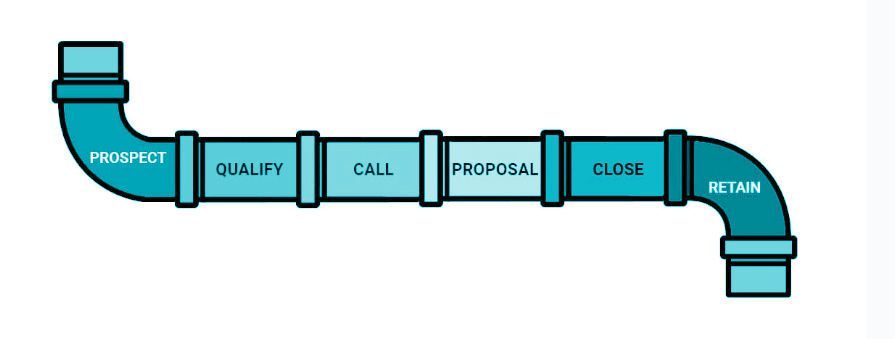
The predictable B2B pipeline model in three layers
The most practical way to stabilize pipeline is to design it as a system with three reinforcing layers.
Layer 1: capture demand with intent
The goal here is to attract buyers who are already close to evaluating vendors. In B2B, the assets that tend to move the needle include:
- solution pages by use case and industry
- comparisons and alternatives
- case studies with operational context
- security, compliance, and integrations content
- “how-to” pieces built for decision-making, not general education
This layer doesn’t just generate traffic—it generates signals, and those signals enable better prioritization.
Layer 2: create demand to open target accounts
Demand creation (ABM, paid, social, email) performs best when it’s tied to a clear hypothesis: “this account has fit and intent, we need to unblock a specific objection.” It’s not about impressions—it’s about movement.
In a healthy B2B pipeline, demand creation does two things:
- increases the number of in-market accounts that actively consider you
- accelerates latent opportunities by reducing friction and shortening stages
Layer 3: commercial activation with rules and speed
This layer turns signals into meetings, and meetings into opportunities. The standard here isn’t “call more.” It’s “act faster and act better.”
Three principles:
- fast response when intent is present
- messaging aligned to role and objection
- an accept/reject system with a stated reason so you can learn
When this layer works, pipeline becomes predictable because it stops depending on individual judgment and starts depending on operating rules.
What to measure so pipeline becomes manageable
A B2B pipeline becomes predictable when you measure stage progression, not just volume. In practice, there are three metric groups leadership cares about.
Input quality metrics
- the percentage of leads or accounts that match your ICP
- sales acceptance rate and rejection reasons
- conversion rate from intent signals to meetings
The underlying question is: “Are we feeding the pipeline with the right inputs?”
Progression metrics
- stage velocity (days spent in each stage)
- stage-to-stage conversion rates
- number of roles involved in enterprise accounts
The underlying question is: “Is our pipeline moving—or stalling?”
Outcome metrics
- opportunities created and weighted value
- win rate and sales cycle length
- marketing-influenced pipeline within target accounts
The underlying question is: “Does this system create revenue repeatedly?”
The critical point most teams don’t standardize
If there’s one lever that reduces friction between teams and improves pipeline predictability, it’s having a formal acceptance step between marketing and sales.
You don’t need a specific label. What matters is a moment where sales decides:
- accept as “workable”
- reject—and state why
This turns pipeline into a learning loop. If most rejections are “not ICP,” the issue is targeting. If rejections are “no intent,” your signals are wrong. If rejections are “not now,” you need better nurturing and trigger-based follow-up.
How to apply this in 30 days without paralyzing teams
A common mistake is trying to redesign everything at once. If your goal is a more predictable B2B pipeline, focus on what moves the needle within a month:
Week 1: ICP clarity and intent signals
Define which accounts you want—and which you don’t. List 5–7 signals that, in your business, most closely resemble real evaluation.
Week 2: decision-stage assets
Strengthen or create assets that resolve common objections: comparisons, case studies, security, integrations, and “how implementation works.” You don’t need 20 pieces—you need 4–6 excellent ones.
Week 3: handoff standard and speed
Define when a lead/account is routed to sales, the response SLA, and a short set of allowed rejection reasons. Make feedback easy to record.
Week 4: executive review and adjustments
Review acceptance, rejection reasons, and conversions. Adjust signals and prioritization. At this point you should see less noise and more focus.
If you want to accelerate implementation with a proven operating model, Sheridan can help you define signals, build decision assets, and align the process without turning it into a never-ending project.
Common mistakes that make pipeline unpredictable
- confusing activity with intent and rewarding what’s easy to generate
- measuring “leads” as success without tracking acceptance and progression
- lacking BOFU assets that resolve real objections
- moving too slowly when intent is clear
- not reviewing rejection reasons and refining the system
Conclusion
A predictable B2B pipeline isn’t built by chasing more volume. It’s built with a system that combines intent capture, demand creation for target accounts, and a rules-based commercial activation layer. When you align signals, assets, and process, forecasting improves, sales regains focus, and pipeline stops depending on campaign spikes. If your priority is stable opportunity flow and leadership-level accountability, this is the kind of approach that turns pipeline into a competitive advantage.
Request your free consultation with our experts right here.
Frequently asked questions
ABM isn’t dead. What’s dead is ABM as “run ads to 20 logos and hope for the best.” In 2026, ABM that works looks less like a one-off campaign and more like a stage-based progression system: you select accounts with real intent, craft role-specific messaging, orchestrate channels with a consistent narrative, and measure progress using signals leadership actually cares about.
This playbook is written for B2B decision-makers with a very specific pain point: “we have target accounts, but they don’t move; pipeline is inconsistent; sales and marketing aren’t synced; and it’s hard to prove impact.” We’ll go phase by phase—the way enterprise deals are actually won.
Phase 1: account selection driven by business criteria
The most underestimated phase in ABM is deciding who not to pursue. Healthy ABM starts with a two-part filter.
Criteria 1: true ICP fit
“Big company” is not enough. In enterprise, poor fit costs you months of cycle time and internal wear and tear. Define 4–6 non-negotiable attributes:
- target vertical
- complexity of the problem you solve
- stack or environment if relevant
- geography and constraints
- buying capacity and likely executive sponsor
Criteria 2: intent signals and momentum
In 2026, chasing cold accounts is a luxury few companies can afford. Look for signals that indicate movement:
- repeated visits from the account to high-intent pages such as pricing, security, integrations, and case studies
- consumption of comparisons or “alternatives to…” content
- spikes in branded search
- engagement from multiple roles, not just one individual
Practical innovation: score accounts by “temperature” using a simple logic: fit + momentum + accessibility. ABM without accessibility often turns into vanity theater.
Phase 2: role mapping and decision-maker narrative
ABM fails when you speak in the singular. In enterprise, purchasing is a choir: each role hears a different song.
The four roles that typically decide and what they care about
- business sponsor: impact, ROI, reduction of operational risk
- lead user: adoption, usability, “this will make my job easier”
- IT and security: control, compliance, integrations, governance
- procurement and finance: predictability, terms, contractual risk
The modern ABM narrative
Instead of creating 20 different messages, build a narrative core and adjust the angle by role. A strong core includes:
- a quantifiable problem
- the cost of inaction
- the proposed change
- proof it works through cases, data, or method
- a low-risk next step
Practical innovation: write the message like a “committee brief”—one sentence per role that fits on a single slide. If it doesn’t fit on a slide, it usually won’t fit in the buyer’s head.

Phase 3: stage-based assets that serve a purpose
In ABM, content is not “content.” It’s strategic ammunition—and the ammunition changes by stage.
Discovery
Goal: make the account say, “this is for us.”
- vertical-specific problem guide
- benchmark or quick diagnostic
- industry landing page with relevant proof
Consideration
Goal: ensure they compare you, not eliminate you.
- honest comparisons
- role-based case studies for business, IT, and users
- “how implementation really works,” including real friction points
Decision
Goal: remove risk and accelerate approval.
- executive one-pager
- security and compliance pack
- phased rollout plan
- quantified value proposition
Practical innovation: create a “forwardable asset.” In enterprise, the content that closes isn’t the prettiest—it’s what someone forwards internally with a “look at this.”
Phase 4: coherent multi-channel orchestration
ABM in 2026 runs like a series, not a movie. It requires short, consistent, measurable sequences.
The channel mix that tends to work in enterprise B2B
- LinkedIn for visibility and social validation
- email to move conversations forward with context
- ads for persistent presence across target accounts
- website content to handle objections with minimal friction
- sales outreach to convert signals into meetings
Synchronization is the difference. If your ad talks about “efficiency,” your email can’t talk about “innovation,” and your landing page can’t promise “cost savings” without proof. ABM breaks from inconsistency, not from lack of budget.
Practical innovation: run two-week “micro-campaigns” around a hypothesis:
- hypothesis: “IT is blocking due to security”
- message: “how we meet X and how implementation works”
- assets: security pack + case + integration guidance
- KPI: increased security-page visits + outreach replies + meetings
Phase 5: marketing and sales coordination with clear rules
If marketing and sales don’t share the system, ABM becomes a cold war.
Minimum rules that prevent chaos
- assign an account owner on the sales side
- set a review cadence weekly or bi-weekly
- define what “progress” means and how it’s recorded
- define which signals trigger sales action
ABM works when the team operates from the same map: what was sent, what was seen, what was answered, and which objection is currently active.
Practical innovation: create an “objection log” per account. This is not CRM bureaucracy—it’s a living document with five fields: objection, role holding it, evidence to resolve it, recommended asset, next step.
Phase 6: ABM measurement that leadership trusts
The classic mistake is measuring ABM like inbound: clicks, leads, CTR. In enterprise B2B, success shows up as account movement.
Metrics that actually reflect progress
- buying-group coverage by number of roles engaged
- high-intent visits per account
- engagement with decision assets such as security, implementation, and case studies
- meetings with sponsor or committee
- opportunities created and stage velocity
- influenced pipeline and win rate in ABM accounts
If your ABM isn’t connected to pipeline, it will always look like “branding.” Connect activity to account progression and the debate ends.
Mistakes that still kill ABM in 2026
- selecting accounts based on ego, not fit and intent
- speaking to IT the same way you speak to the executive sponsor
- creating content with no function in the buying cycle
- running channels as silos without a consistent narrative
- measuring clicks when the objective is committee progress
Conclusion
The ABM that closes enterprise accounts in 2026 isn’t more complex—it’s more disciplined. It runs in phases, with role-based narrative, assets designed to be forwarded, real coordination with sales, and metrics that reflect account progression. If your target accounts feel “stuck,” the issue is rarely lack of impressions—it’s lack of sequence, proof, and system.
Request your free consultation with our ABM experts right here.
Frequently asked questions
Classifying “high-value” leads should accelerate pipeline, not create ongoing friction between marketing and sales. Yet in many B2B organizations, B2B lead scoring still relies on superficial signals—clicks, downloads, one-off visits—that generate volume but not meaningful sales conversations. The outcome is familiar: sales loses confidence in inbound leads, while marketing feels that “no one follows up” on what’s being handed over.
The most practical evolution in 2026 is to move from an MQL-centered scoring model to one that incorporates buying intent and, when there is a product, signals of experienced value to activate PQLs. This approach doesn’t just prioritize better; it also creates a shared language across teams.
Why traditional MQL is no longer enough
Classic MQL scoring is built by combining ICP fit and content engagement: role, industry, and company size, plus downloads, webinars, or email opens. It’s a useful model to organize the top of the funnel, but it fails when it’s treated as a “passport” to sales.
The reason is simple: consuming content doesn’t always mean someone is ready to buy. As the document summarizes clearly, a large share of traditional MQLs don’t convert because informational interest is not the same as commercial intent. In B2B—where buying committees, long cycles, and multiple motivations are the norm—that gap becomes even larger.
If your pain point is “we have plenty of leads, but not many good ones,” the issue is usually that scoring rewards easy-to-generate activity and underweights signals that are harder to earn but far more predictive.
What a PQL is and why it changes pipeline quality
A PQL is based on something different: not on what a lead says or reads, but on the value they demonstrate inside the product. This approach is especially powerful in freemium and free-trial models, where you can observe actions that correlate with adoption and, therefore, with purchase.
A PQL is triggered when the user reaches concrete milestones: inviting teammates, exceeding usage thresholds, or configuring key integrations. These actions often indicate the lead has found a real use case and is building operational dependence—exactly what a B2B decision-maker wants to see before committing budget.
The strategic implication is significant: B2B lead scoring stops being a “temperature check” for interest and becomes a predictor of intent backed by evidence.
The layers of modern B2B lead scoring
A strong system doesn’t stand on a single signal. It stands on layers that together tell a coherent story: fit, intent, and evidence.
Fit with the ICP
Fit answers a leadership-level question: “even if they buy, is this the customer we want?” This includes size, industry, geography, digital maturity, and commercial viability variables. This layer is your guardrail: it prevents a highly active lead from rising to the top if they don’t actually match your offer or your margin structure.
In practice, many B2B companies set a minimum fit threshold so the rest of the signals have meaning. Without that filter, scoring becomes a machine for prioritizing curiosity.
High-intent behavior and engagement
Intent isn’t measured by “a lot of traffic,” but by signals close to a decision. The document highlights the weight of high-intent pages such as pricing, as well as visit frequency and behavior across key assets. In B2B, the following often matter as well:
- comparison and alternatives pages
- industry-specific case studies
- security and compliance content
- implementation, integrations, or migration pages
- repeated visits within short time windows
The difference between mediocre scoring and useful scoring is often here: separating exploratory consumption from evaluative behavior.
Product signals that activate PQL
When you have a measurable product, this layer typically correlates best with revenue. The document presents it as the strongest sales trigger when real product usage is integrated.
What matters less is “how much” the user does, and more “what” they do. The most effective recommendation is to define one or two events that represent the moment when value becomes tangible, and use them as triggers for commercial prioritization. In B2B, it’s also important to shift focus from the individual to the account: team invites, multi-user setup, permissions, and integrations with core systems.
Predictive prioritization with AI
The document describes a fourth layer where algorithms adjust scores in real time and identify complex patterns such as interaction speed or buying-group behavior. This can add substantial value, but there’s a condition in B2B environments: prioritization must be explainable. If sales doesn’t understand why a lead is at the top, internal adoption drops.
A strong implementation uses AI to refine weights and detect meaningful combinations of signals, while maintaining a clear interpretive framework for the commercial team.
The step that prevents conflict: SAL as an operating standard
One of the most useful changes in mature B2B organizations is formalizing SAL. The document presents it as the bridge: marketing identifies MQL or PQL, sales accepts the lead as valid after a quick validation, and only then does it become an SQL when real need, authority, and timing are confirmed.
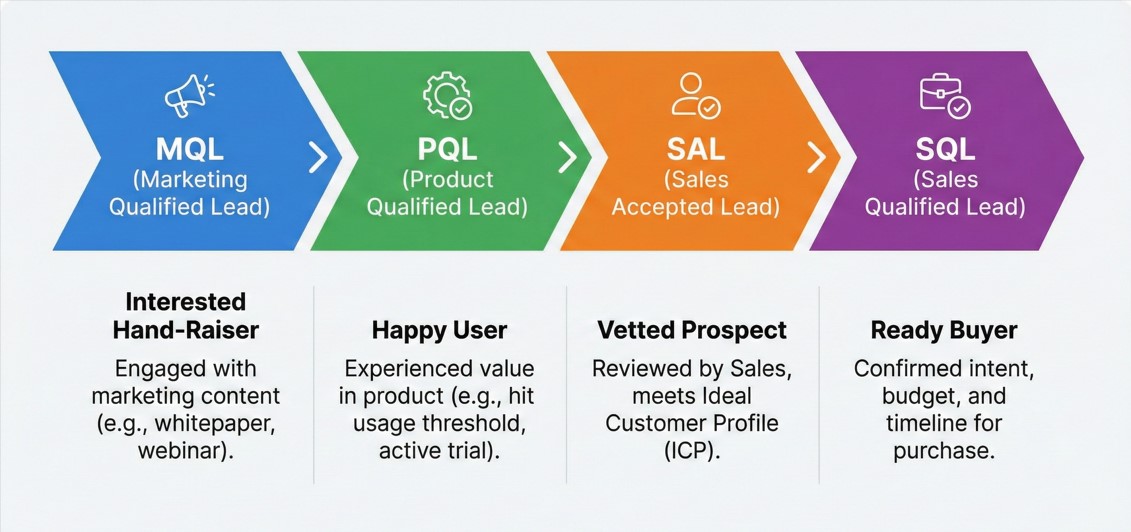
This solves a classic issue: without an intermediate state, marketing measures “delivered” and sales measures “useful,” but nobody measures the point where the lead is accepted or rejected with a reason. SAL enforces discipline:
- sales must accept or reject with feedback
- marketing adjusts scoring using real evidence
- leadership gains visibility into the handoff and its bottlenecks
For decision-makers, SAL isn’t bureaucracy—it’s pipeline quality control.
Current frameworks to qualify without slowing commercial execution
BANT still exists, but in digital B2B environments, frameworks that prioritize intent and observable signals often work better. The document highlights AIQ, FASTER, and MQAs.
- AIQ helps prioritize quickly when funnel volume is high and you need to decide who to call first.
- FASTER expands analysis for more complex scenarios, where fit and timing matter as much as activity.
- MQAs fits especially well in ABM, because it reflects the B2B reality: accounts buy, not individual leads.
The goal isn’t choosing the trendiest framework, but standardizing one that sales can use without friction and marketing can fuel with consistent signals.
How to implement a model without paralyzing teams
If your goal is to classify high-value leads reliably, implementation should prioritize speed of learning over perfection:
- define a realistic ICP and exclusion criteria
- identify high-intent signals specific to your buying process
- set one or two PQL events if you have instrumented product usage
- formalize SAL with mandatory acceptance or rejection
- review the model regularly using conversion data and sales feedback
This approach reduces subjective debate and replaces it with continuous improvement.
Typical mistakes that inflate volume and reduce quality
- rewarding easy-to-generate actions that correlate weakly with purchase
- scoring individuals instead of accounts, ignoring the buying group
- sending leads to sales without formal acceptance or a rejection reason
- failing to review weights when campaigns, product, or value proposition change
- relying on AI without clear rules for explanation and governance
Conclusion
A B2B lead scoring model that works isn’t chasing “more leads”—it’s chasing better sales conversations. The shift from MQL to PQL, the use of high-intent signals, and the formalization of SAL create a system where marketing and sales share criteria and learn from real data. If your team struggles to classify high-value leads today, the fastest path isn’t adding more points to the score—it’s redesigning which signals represent a decision and which represent simple consumption.
Request your free consultation with our experts right here.
Frequently asked questions
As Sheridan Agency, we provide AI SEO services for B2B brands. On our own website we already rank for more than 14 keywords that trigger Google AI Overviews, including cases like Blaxtair. In B2B, this matters even more because visibility no longer happens only when someone searches, but also when AI systems “recommend” sources during the research phase.
What AI SEO is and why it matters more in B2B
AI SEO, also referred to as GEO or LLMO, means optimizing your digital presence for two scenarios at the same time:
- Keep winning rankings and clicks in traditional search.
In B2B, this is still critical to capture long-tail demand (“software X for Y,” “how to reduce Z,” “alternatives to…”) and to feed sales with qualified traffic. - Be selected as a source when AI generates an answer.
This is where the game changes: in B2B, many buyers research before speaking with sales. If AI summarizes “best practices,” “vendors,” “buying criteria,” or “comparisons,” you want to be included as a credible reference. - Influence the buying committee without relying on a single click.
B2B is rarely an individual purchase. You have the user, the sponsor, IT, procurement… and each role asks different questions. AI SEO helps you show up at more points in the journey, from “what is” to “security,” “integrations,” and “ROI.”
What AI considers “citable content” in B2B
1) Clarity and extractable structure because B2B is researched in pieces
In B2B, content is consumed in scan mode: someone wants a quick answer, a criterion, a benchmark, a requirements list. That’s why structure wins.
- Definition and context upfront: if you don’t clearly state “what it is” and “who it’s for,” AI has less clean material to extract.
- H2/H3 as real buyer questions: “Which security requirements should we ask for?”, “How do we evaluate vendors?”, “Which metrics matter?”
- Lists and comparisons: they work especially well in B2B because the user is trying to decide, not be entertained.
- Self-contained blocks: each section should make sense on its own. This increases “citability.”
Key B2B idea: the content that travels best into AI Overviews often looks like a mini evaluation sheet—criteria, steps, requirements, common mistakes.
2) Credibility through E-E-A-T in B2B: proof, not claims
In B2B, credibility is not optional. Buyers are trying to reduce risk, and AI systems tend to prioritize signals that look like “trusted sources.”
- Cases and evidence: “we work with X industries,” “we achieved Y in SERPs,” “learnings after Z implementations.” In your case, the “14+ keywords with AI Overviews” signal strengthens authority because it is concrete.
- Authorship and accountability: team pages, methodology, contact information, and when relevant, experts by area (technical, content, strategy).
- Sources and precision: if you talk about security, use clear concepts (SSO, RBAC, audit logs, SOC 2, GDPR) without guessing.
- Entity consistency: same naming, same services, same categories. In B2B, a brand is “learned” through consistent repetition.
3) Dynamic content because in B2B “outdated” feels risky
In B2B services and software, outdated content is interpreted as lack of rigor.
- Visible update dates on strategic assets (guides, comparisons, buying criteria).
- Living FAQs: questions change as the market evolves (AI Overviews, SERP shifts, new tools).
- A “changes and learnings” section: “what changed this quarter” works well because it turns your website into a continuous reference.

How to write B2B content AI can use without sounding like a boring manual
1) Answer like a consultant, not like a generic blog
A pattern that works in B2B is: context → criteria → decision → next step.
- Context: why it matters
- Criteria: how to evaluate it
- Decision: what to choose based on scenarios
- Next step: how to implement it
This covers search intent and also produces reusable material for AI-generated answers.
2) Turn every URL into an evaluation asset
In B2B, the highest-converting content tends to be:
- practical guides
- honest comparisons
- “alternatives to…” pages
- buying criteria
- templates (even if you don’t include a checklist in the post, you can offer a downloadable)
For AI, these formats are gold because they are structured and easy to cite.
3) Address the topic by role because committees ask different questions
Example for AI SEO:
- Marketing: visibility, demand, branded search, AI Overviews
- Sales: objections, comparisons, materials for the sales cycle
- Leadership: risk, ROI, pipeline impact
- IT and Legal: compliance, privacy, control
If your content covers 2–3 of these roles, you gain B2B depth without inflating word count.
4) Work in clusters aligned to the buyer journey
In B2B, the ideal cluster often maps like this:
- Awareness: what it is and why it matters
- Consideration: how to do it, best practices, common mistakes
- Decision: vendors, alternatives, cases, pricing
- Retention: measurement, iteration, scaling
That map is exactly what helps AI perceive you as a topical authority.
Minimum technical foundations that make the difference in B2B
1) Schema and semantics so systems understand your entity and your content
In B2B, it helps to reinforce:
- Organization (brand plus consistent data)
- Article or BlogPosting (informational pieces)
- FAQPage if you have real FAQs
- BreadcrumbList for site architecture
It’s not “for schema’s sake.” It’s to reduce ambiguity and help AI understand what is what.
2) Site architecture and internal linking as your website’s mental model
In B2B, a chaotic website kills authority. What works:
- one pillar per topic (AI SEO)
- satellites per subtopic (AI Overviews, LLMO/GEO, measurement, cases)
- contextual internal links (not “click here”)
This guides crawling and users alike: less friction means more trust.
3) UX and performance because B2B buyers also bounce
Even if the buyer is “serious,” they leave if they don’t find answers fast. In B2B, time is expensive.
4) llms.txt as support, not a solution
It can add a small signal, but it does not replace useful content, structure, authority, or freshness. In B2B, if the fundamentals are missing, llms.txt won’t save you.
Authority and mentions because in B2B it’s what others say about you
This is the part you notice when a brand starts being cited.
1) PR and citable assets
In B2B, what gets cited most often includes:
- studies (owned or collaborative)
- benchmarks
- frameworks
- industry reports
- technical glossaries
- comparisons with transparent criteria
You don’t need a massive annual report. A well-executed quarterly mini-report already creates strong signals.
2) Cases and social proof without hype
AI and humans trust evidence:
- “14+ keywords with AI Overviews”
- “verticals where it works best”
- “content types that show up most in summaries”
- examples of pages without exposing sensitive data
3) Entity consistency as a core B2B advantage
The more consistent you are, the easier it is to “identify” you:
- fixed naming
- same value proposition
- same services
- strong team and case pages
How to measure AI SEO in B2B without guessing
1) Business indicators that the committee understands
In B2B, connect “AI visibility” to metrics leadership recognizes:
- presence in AI Overviews by keyword
- mentions and citations when available
- brand search lift (“I saw you recommended”)
- assisted leads, not only last-click
- pipeline impact when you can track it
2) A simple control method you can maintain
- define clusters by theme
- assign a keyword list per cluster
- review AI Overview presence on a regular cadence
- note which format appears (FAQ, list, comparison)
- iterate based on what works
This is especially useful in B2B because it helps justify decisions to leadership: “we’re winning presence through X type of content.”
Common B2B mistakes and how to avoid them with context
Nice-looking content that is useless for decision-making
Talking about AI without criteria, steps, or examples. Fix: add decisions (“if you are X, do Y”).
Not addressing committee objections
Marketing speaks, but IT, Legal, and Procurement can’t find answers. Fix: sections on security, integrations, governance, and measurement.
Biased or empty comparisons
In B2B it shows quickly. Fix: comparisons with transparent criteria.
No proof
Promising “you’ll appear in ChatGPT” with no evidence. Fix: cases, methodology, SERP data.
No maintenance
In AI topics, old content looks like incompetence. Fix: visible, regular updates.
If you want your B2B brand to appear as a source in AI Overviews and generative responses, you need an AI SEO strategy based on clear and quotable content, real authority, and impeccable technical structure. If you’re interested in applying this to your case and starting to gain visibility for the keywords that drive your business, talk to us and we’ll tell you how we work on projects like yours.
Frecuently asked questions
In a SaaS business model—where scalability and retention are foundational—data isn’t just for reporting. It’s a strategic decision-making tool. Choosing and monitoring the right SaaS KPIs is essential to spot growth opportunities, improve efficiency, and protect long-term profitability.
In this guide, we explain the must-track metrics for B2B companies built around software as a service.
Why are KPIs so important for B2B SaaS companies?
Unlike other models, SaaS businesses don’t rely solely on the initial sale—they rely on a long-term customer relationship. Sustainable growth is not possible without a clear metrics framework that helps you understand what’s working, what isn’t, and what actions to take.
Well-defined KPIs help you:
- Measure the impact of your marketing, sales, and customer success efforts accurately.
- Evaluate the efficiency of your acquisition and retention model.
- Align teams around shared goals through common indicators.
- Optimize processes, resources, and budget based on real data.
In short, KPIs act as a compass that lets you scale with control and predictability.
Core SaaS KPIs for marketing, sales, and growth
1. MRR (Monthly Recurring Revenue)
MRR is the foundational metric for any SaaS business. It represents your recurring monthly revenue and is the best way to track true growth without seasonal distortions or one-off sales.
MRR should be broken down into new revenue, expansion (cross-sell/upsell), and losses from cancellations or downgrades to get a clear view of net performance.
2. CAC (Customer Acquisition Cost)
CAC measures how much it costs to acquire a new customer, including all related marketing and sales expenses. It’s essential for understanding whether your growth strategy is sustainable.
A high CAC isn’t necessarily bad if it is supported by a high LTV. What matters is keeping the relationship between them healthy and optimizing acquisition cost without sacrificing lead quality.
3. LTV (Customer Lifetime Value)
LTV estimates the total economic value a customer generates during their entire relationship with your company. It’s calculated by multiplying average revenue per customer by the average customer lifespan.
This KPI helps determine how much you can invest in acquisition without jeopardizing profitability. In SaaS, an LTV/CAC ratio of at least 3:1 is typically considered healthy.
4. Churn Rate
Churn rate shows the percentage of customers who cancel their subscription in a given period. It’s one of the most sensitive SaaS metrics because high churn can wipe out even strong acquisition efforts.
It’s recommended to separate customer churn from revenue churn (MRR churn), since losing one large account can have a bigger impact than losing several smaller ones.
5. User Activation
Activation measures the percentage of users who reach the key value moment (the “aha moment”) after signing up or subscribing. This metric is directly tied to retention and product usage.
Each company must define activation based on its product. It could be completing a critical task, configuring a feature, or generating the first tangible outcome.
6. Lead-to-Customer Conversion Rate
This KPI measures how efficiently your sales funnel converts qualified leads into paying customers.
A low conversion rate can indicate friction in the sales process, poor segmentation, or misalignment between what marketing promises and what sales delivers.
7. MQLs and SQLs
The difference between Marketing Qualified Leads (MQLs) and Sales Qualified Leads (SQLs) is critical for aligning marketing and sales.
Tracking how many marketing-generated leads become real opportunities—and how they progress through the pipeline—helps improve campaign quality, optimize resources, and shorten the sales cycle.
Strategic complementary metrics
ARPU (Average Revenue Per User)
ARPU helps assess profitability per account and identify upsell opportunities or pricing segments that need adjustment.
NPS (Net Promoter Score)
A loyalty metric that can anticipate retention and organic growth potential. High NPS scores often correlate with lower churn and higher expansion.
Payback Period
Measures how long it takes to recover the investment spent to acquire a customer. The shorter the payback period, the more efficient your acquisition model.
Expansion Revenue
Revenue generated through upgrades or cross-sells. It reflects your product’s ability to grow inside existing accounts, reducing dependence on constant acquisition.
KPIs by stage of the SaaS funnel

Best practices for implementing and using SaaS KPIs
Prioritize quality over quantity
Avoid measuring everything by inertia. Define the most relevant KPIs based on your maturity stage, customer type, and business goals. Fewer metrics—but more actionable.
Align every team around the same indicators
SaaS success depends on collaboration. When marketing, sales, and product share KPIs, friction decreases and decision-making improves.
Automate data collection and visualization
Connect your sources (CRM, billing platform, marketing tools) and build clear dashboards in tools like Looker, Power BI, or ChartMogul. Real-time access is essential.
Review and adjust every quarter
KPIs should drive action. Review them regularly, identify deviations, generate hypotheses, and adjust strategy. Measurement without decisions has no impact.
How Sheridan can help you optimize your SaaS KPIs
At Sheridan, we work with B2B SaaS companies that need more than data—they need direction. We help define strategic KPIs, connect data sources, and build funnels designed for profitable growth.
Our experience includes:
- Implementing measurement models aligned across marketing, sales, and customer success.
- Automating executive reporting and dashboards.
- Full-funnel acquisition campaigns optimized for CAC and LTV.
- Content and retention strategies built on real data.
If your SaaS company wants to scale with clarity and profitability, we’re ready to help you turn metrics into decisions.
Book a strategy session with our team and discover how we can help.
Frequently asked questions
Implementing AI in your B2B marketing strategy is no longer optional—it’s a competitive advantage. Here’s how to use it effectively to generate more and better leads, automate key processes, and increase ROI.
Why AI has become essential in B2B marketing
B2B is complex: multiple decision-makers, long sales cycles, and highly technical products. In this context, AI helps you:
- Analyze large volumes of customer and behavioral data
- Personalize content and messaging by industry, role, or funnel stage
- Optimize multichannel campaign management with greater precision
- Automate key processes to scale demand generation
More than 70% of B2B companies already use AI in at least one phase of their marketing.
The main ways to use AI in B2B marketing
1. Personalized content generation at scale
With generative AI tools such as ChatGPT or Gemini, you can produce articles, emails, ad copy, and landing pages tailored to each buyer persona much faster and more efficiently. This is especially valuable in technical industries where content must deliver real, practical value—not generic commentary.
2. Workflow and campaign automation
From lead nurturing sequences to multichannel workflows, AI enables campaigns that react to user behavior in real time. This is ideal when integrated with CRMs like HubSpot or Salesforce, where triggers, segmentation, and routing can be automated without losing control of the customer journey.
3. Predictive lead scoring
AI can identify patterns and prioritize leads with stronger buying intent, improving sales team focus and increasing conversion rates. Instead of scoring only on surface engagement, predictive models can incorporate a wider range of signals to better distinguish “interested” from “ready.”
4. Advanced Account-Based Marketing
AI makes ABM more precise by enabling hyper-personalized messaging, identifying target accounts, and adapting content based on industry or buying cycle stage. This increases the effectiveness of complex ABM programs, where relevance and timing are decisive.
5. Behavior analysis and prediction
AI-driven tools can predict which content and channels are likely to perform best, improving strategic planning and media investment. The objective is to move from reactive optimization to proactive decision-making.
How AI solves the biggest B2B marketing challenges
B2B teams face recurring challenges that AI can mitigate effectively:
Lack of brand differentiation
Markets are saturated. AI can support the creation of distinctive, consistent content that improves visibility and strengthens positioning.
Strategies without focus
AI helps structure the funnel, connect marketing and sales activities, and make decisions based on data rather than intuition.
Measurement issues
Many companies don’t trust their reporting. AI can help visualize KPIs in real time and generate actionable insights—not just dashboards.
Limited resources
With AI, smaller teams can operate with “scaled” capacity by automating repetitive work and focusing human effort on strategy and differentiation.

Best practices for applying AI in B2B marketing
Define your strategy before choosing tools
Don’t start with technology. Start with goals: more leads, higher conversion, better analysis, lower CAC. Then select tools that serve those outcomes.
Align marketing, sales, and technology
AI requires integration. Involve the relevant stakeholders from the beginning to avoid disconnected initiatives and data silos.
Protect data quality
AI is only as effective as the data it learns from. Audit your data sources and ensure consistent taxonomy, governance, and hygiene before you automate.
Use AI as support, not a replacement
Human strategy and creativity remain essential. AI should function as a co-pilot—accelerating execution and insights—while your team stays accountable for positioning and decisions.
Real-world success with AI and automation in B2B
B2B companies that implemented AI-driven strategies together with Sheridan achieved:
- 42% more leads year over year
- 13% lower cost per conversion through campaign optimization
- 60% more keywords ranking in Google Top 10 through AI-assisted content and advanced SEO strategy
- Conversion rates of 5.69% versus a B2B average of 3.71%
The future of B2B marketing will be predictive and automated
Teams that master data integration, automation, and predictive analytics will be better positioned. AI doesn’t just help you react—it helps you anticipate. In markets with fierce competition and complex buying decisions, AI becomes a catalyst for sustainable growth.
Why Sheridan can help you apply AI strategically
At Sheridan, we combine technology, business, and creativity to scale B2B growth with AI through a proven approach:
- Omnichannel consulting and execution across SEO, paid media, social, and ABM
- AI-assisted content production adapted to complex buyer personas
- Implementation of automated nurturing, scoring, and sales follow-up workflows
- Demonstrated results across multiple B2B sectors including industry, pharma, tech, and construction
Ready to take your B2B demand generation further with AI
Book a strategy session with our team and discover how we can help.
Frequently asked questions
The B2B SaaS model has become a cornerstone for companies seeking to scale, optimize processes, and make data-driven decisions. Thanks to cloud technology, organizations gain access to flexible and up-to-date software without relying on local infrastructure, enabling them to improve collaboration, automate critical activities, and accelerate operational efficiency.
This article summarizes the essential aspects of B2B SaaS, its impact on business management, key tools, emerging trends, and the best strategies for achieving sustainable growth.
What is B2B SaaS and how does it work?
Software as a Service (SaaS) allows companies to use cloud-hosted applications through a subscription. This model offers:
- Full accessibility: access from any device, favoring hybrid teams.
- Automatic updates: ensures the availability of new features without interruption.
- Enhanced security: encryption, multi-factor authentication, and continuous audits.
- Lower implementation cost: reduces investment in hardware and maintenance.
Key features of B2B SaaS
- Flexibility and scalability: allows you to adjust capabilities and licenses according to your needs.
- Connecting teams: facilitates real-time collaboration.
- Subscription model: improves financial forecasting and allows testing tools before full adoption.
Differences between B2B and B2C within SaaS
The B2B approach differs from other models, such as B2C (Business to Consumer), in several key aspects. While B2C focuses on direct sales to the end consumer, B2B is geared towards facilitating collaboration and processes between businesses. This distinction affects how SaaS solutions are designed and marketed.
- More complex relationships: B2B transactions typically involve more complex decisions and multiple stakeholders compared to B2C relationships.
- Customized needs: B2B customers require solutions tailored to their specific needs and internal processes.
- Contract duration: In B2B, agreements are usually long-term, which implies a more strategic approach to the customer relationship.
Main SaaS tools and applications for businesses
B2B SaaS solutions cover virtually all business processes. Among the most relevant categories are:
CRM for customer and sales management
B2B CRMs allow you to centralize account information, automate sales processes, and improve the conversion of leads into actual opportunities. Their advanced features include:
- Tracking interactions, pipeline, and lead activity.
- Audience segmentation and predictive analytics.
- Integration with automation and ERP tools.
Software for project management and productivity
Project management tools enhance efficiency by:
- Kanban boards, task assignment and deadline control.
- Cross-departmental collaboration.
- Real-time metrics on progress and workload.

Marketing automation and digital campaigns
Marketing automation is becoming a crucial tool for businesses looking to optimize their campaigns. These solutions allow companies to schedule tasks, analyze results, and segment audiences, improving the effectiveness of their marketing strategies. Automation platforms enable the execution of comprehensive strategies:
- Automated sending of segmented emails.
- Coordinated management of social media and paid campaigns.
- Lead nurturing with behavior-based workflows.
These tools are essential for scaling the acquisition funnel and nurturing leads into SQLs.
Solutions for financial management and ERP
Financial management solutions are another essential component within the SaaS environment. They help companies maintain rigorous control over their financial resources and better plan for their future needs. SaaS-based ERPs help to:
- Control accounting, invoicing and reporting.
- Reduce errors and save time with automation.
- Unify cross-functional information between areas.
Integration and security: pillars of modern SaaS
Integration and security are fundamental aspects of SaaS platforms, as they determine the operational efficiency and data protection of organizations. These elements offer confidence and convenience to companies that adopt these solutions. The ability to integrate with the company’s digital ecosystem is one of the most decisive factors when choosing a B2B SaaS.
Integration with existing systems
Integrating SaaS platforms with existing business systems is a priority for organizations seeking to maximize efficiency. Integration capabilities allow different applications to work synergistically, facilitating a seamless flow of information. APIs enable SaaS to connect with:
- CRM
- Marketing platforms
- Human resources systems
- ERPs
- Internal applications
This reduces duplicate tasks, improves information flow, and speeds up decision-making.
Security and regulatory compliance
Data security is a critical aspect of the SaaS environment, as companies handle sensitive and confidential information. SaaS providers implement measures such as:
- Encryption in transit and at rest
- Multi-factor authentication
- Periodic audits
- Privacy policies aligned with GDPR
Furthermore, compliance with regulations such as GDPR and HIPAA is essential for companies that handle personal data. Providers must offer guarantees that their platforms are aligned with the relevant legal requirements. Their ability to manage automatic updates ensures maximum protection without any operational burden for the client.
Emerging trends in B2B SaaS
The SaaS ecosystem is evolving rapidly, driven by technologies that are redefining the way businesses operate.
Generative AI and machine learning
Artificial intelligence (AI) and machine learning are revolutionizing access to education. These technologies are being integrated into educational management platforms to offer personalized experiences tailored to each student’s needs. AI allows for the analysis of user behavior and the prediction of their requirements, facilitating the creation of customized materials and courses.
The implementation of chatbots, for example, allows for more efficient customer service, facilitating real-time resolution of queries. These tools not only optimize the user experience but also alleviate the workload of educational staff. AI enables:
- Personalize experiences and automate decisions.
- Analyze user behavior.
- Create content, automate campaigns, and improve support.
Chatbots, for example, offer immediate assistance and reduce operational burden.
Vertical solutions and advanced customization
SaaS specialization is growing: tools are being adapted to sectors such as industry, technology, energy, construction, and professional services. This allows for the adjustment of workflows, integrations, and data models to each business operation.
IoT and real-time data
The integration of the Internet of Things (IoT) into the B2B SaaS sector is changing how data is collected and used. Connected devices allow institutions to gain real-time insights into student performance and behavior. This data collection facilitates informed decision-making regarding academic development and resource management.
On the other hand, the ability to manage this data effectively helps institutions identify areas that require attention or improvement, thus optimizing administrative processes. Thanks to connected devices, companies obtain instant information on performance, activity, and processes. This enables faster decision-making and reduces inefficiencies.
Blockchain for greater transparency
The integration of blockchain promises to increase transparency and security in data management. This decentralized system allows for more effective tracking of credentials, preventing fraud and ensuring the accuracy of information.
Furthermore, the use of smart contracts can automate administrative processes, making business operations more efficient. This allows companies to focus on improving product quality, eliminating conflicts related to data management. It enables traceability, secure data verification, document control, and the elimination of intermediaries in critical processes.
Growth strategies for B2B SaaS companies
Clear and differentiated value proposition
Growth and optimization are fundamental for software-as-a-service companies. Through various strategies, resources can be maximized and a competitive advantage secured in the market. To stand out in a competitive market, SaaS companies must:
- Show tangible and measurable benefits.
- To emphasize the importance of specialization within the sector.
- Showcase proven achievements and tangible outcomes.
Flexible pricing models
Establishing an effective pricing model is key to attracting and retaining customers. Many vendors opt for flexible pricing structures, which facilitate software adoption, including pay-as-you-go options and monthly subscriptions. The most common strategies include:
- Pay-as-you-go
- Scalable subscriptions
- Free demos
- Prices tailored to the size of the company
These formulas reduce barriers to entry and accelerate adoption. B2B SaaS providers often offer complementary services that enhance the user experience. Some of these include:
- Training and development for staff.
- Regular software updates at no extra cost.
- Advice on the implementation of the tools and their integration with existing systems.
Regarding subscription models, most providers offer flexible options that adapt to the needs and budgets of educational institutions, allowing for better financial and administrative planning.
Customer service as a retention driver
Providing excellent customer service is fundamental for any SaaS company. Users need to feel supported and have access to technical support when they need it. Ticketing systems, live chat, and online resources, such as tutorials and FAQs, are essential for facilitating problem resolution. Proactive support that anticipates potential issues can increase customer satisfaction and loyalty.
Furthermore, ongoing training on how to use the platform leads to greater utilization of the software and a reduction in user churn. Robust support increases satisfaction and decreases churn.
- Live chat
- Knowledge base
- Centralized ticketing
- Ongoing professional development
Strategic alliances and co-marketing
Forming strategic alliances is an effective way to expand your user base. Collaborating with other companies in the SaaS or technology sector can open doors to new markets and audiences. Through integrations, co-marketing, and referral programs, synergies can be created that benefit both parties. Collaborations allow you to:
- Expand the user base.
- Increase visibility in new verticals.
- Integrate complementary solutions.
Key metrics for evaluating a B2B SaaS solution
Usage and adoption indicators
Tracking the adoption of SaaS tools is crucial for understanding how users interact with the software. Some of the most relevant indicators include:
- Frequency of use: How many times users access the platform each week or month.
- Session duration: Average time users spend in the application, indicating their level of engagement.
- Activation rate: Number of users who complete defined key actions, such as account setup or completion of an initial task.
ROI and cost savings
Evaluating return on investment (ROI) is essential to determine if B2B SaaS solutions are generating significant benefits. To do this, the following should be considered:
- Operating costs: Comparison of expenses on technology and resources with the savings achieved through automation.
- Revenue increase: How the use of the software has contributed to increased sales or improved efficiency in other key areas.
Customer satisfaction and retention
Customer satisfaction is a direct indicator of the success of a SaaS solution. It can be measured using:
- Satisfaction surveys: Periodic evaluations that allow us to know the opinion of users on various aspects of the software.
- Retention rate: Proportion of users who continue to use the application over time, a key metric that indicates customer loyalty.
Leveraging data to inform strategic decision-making.
B2B SaaS platforms generate a significant amount of data that can be leveraged for strategic decision-making. Some ways to use this data include:
- Behavioral analysis: Identifying patterns in software usage that can guide future optimizations.
- Product performance
- Usage patterns that can inform new functionalities and enhance advanced reporting: Creation of detailed reports that make it easier to visualize outcomes and long-term trends.
Why choose Sheridan for your B2B SaaS strategy
At Sheridan, we create business. Our specialization in B2B marketing and sales allows us to support SaaS companies in building comprehensive strategies for customer acquisition, automation, and growth.
We offer:
- Unified strategic vision
- Omnichannel execution
- Ongoing refinement of the conversion funnel
- Alignment between marketing and sales
- Experience in SaaS, industrial and technology sectors
We are a strategic partner, not just a marketing agency. Request your free consultation with our experts right here.
{“@context”:”https://schema.org”,”@type”:”FAQPage”,”mainEntity”:[{“@type”:”Question”,”name”:”¿Qué es un SaaS B2B?”,”acceptedAnswer”:{“@type”:”Answer”,”text”:”Un SaaS B2B es un software basado en la nube diseñado para empresas, ofreciendo soluciones que se usan mediante suscripción y que permiten escalar, automatizar procesos y reducir costes operativos.”}},{“@type”:”Question”,”name”:”¿Qué hace una agencia especializada en SaaS B2B?”,”acceptedAnswer”:{“@type”:”Answer”,”text”:”Una agencia especializada en SaaS B2B trabaja en acelerar el crecimiento del software, optimizando adquisición de usuarios, estrategia de contenidos, posicionamiento, automatización y conversión en todo el funnel.”}},{“@type”:”Question”,”name”:”¿Cómo puede mejorar mi empresa de SaaS?”,”acceptedAnswer”:{“@type”:”Answer”,”text”:”Tu empresa de SaaS puede mejorar mediante una estrategia que optimice el funnel completo: más visibilidad, mejor cualificación de leads, mayor retención y un posicionamiento claro frente a la competencia.”}},{“@type”:”Question”,”name”:”¿Por qué es importante el marketing especializado para un SaaS B2B?”,”acceptedAnswer”:{“@type”:”Answer”,”text”:”El marketing especializado para un SaaS B2B es importante porque adapta los mensajes, el contenido y la estrategia a ciclos de venta más largos y técnicos, asegurando que cada interacción aporte valor y convierta mejor.”}}]}Frequently asked questions
B2B marketing continues to evolve at a breakneck pace. As we move into 2026, businesses will need to stay abreast of the latest trends to remain competitive and generate long-term value. Here, we explore the top B2B marketing trends for 2026 and how they can be implemented to improve your business results.
1) Artificial intelligence and automation
Artificial intelligence (AI) and marketing automation will continue to transform the B2B marketing landscape in 2026. AI tools will enhance companies’ ability to personalize customer experiences and predict behavior, enabling more accurate lead generation and optimized sales strategies.
How to use AI in B2B marketing:
- Email automation and tracking: Use AI to personalize marketing messages and perform automated follow-ups based on user behavior.
- Predictive analytics: Using AI to analyze large volumes of data and predict customer actions, helping to make more informed decisions about campaigns and strategies.
- Chatbots and automated customer service: Improve customer interaction through intelligent chatbots that provide instant answers and personalized solutions.
Implementing AI in your B2B marketing strategies not only improves efficiency, but also reduces operational costs and enhances the customer experience.
2) Personalized and highly relevant marketing
Personalization isn’t new, but by 2026, it will reach unprecedented levels in B2B marketing. Companies can no longer afford a one-size-fits-all approach. B2B customers expect personalized offers tailored to their exact needs, making large-scale personalization essential.
How to achieve effective personalization:
- Advanced segmentation: Use big data and analytics tools to segment your audience into much more specific groups, based on behaviors, interests, and past decisions.
- Dynamic content: Develop content that can adapt in real time to the user’s interests and preferences. For example, use dynamic content tools in emails and websites.
- Personalized experiences in real time: Offer personalized experiences through platforms that adapt to the customer’s past interactions with the brand.
Advanced personalization will generate a better user experience, fostering deeper and more lasting relationships with customers.
3) Video marketing and visual content
- Explanatory videos: Use short videos to show how your product or service works. Tutorial or demo videos can increase your conversion rate, as they help prospects visualize the value of your solution.
- Video case studies: Present video case studies to dynamically show how your product has solved specific problems for other companies.
- Interactive webinars: Webinars will continue to be essential for customer education and relationship building. They also allow for direct interaction with potential customers.
Video is not only effective at capturing the attention of leads, but it also improves brand retention rates.
4) Conversational marketing and chatbots
Conversational marketing is emerging as one of the strongest trends in B2B marketing. As consumer expectations rise, companies must offer quick responses and interactive experiences. Chatbots and live messaging tools will play a crucial role in B2B marketing by 2026.
Implementation of conversational marketing:
- Chatbots for customer service: Implement chatbots that can answer frequently asked questions and guide leads through the initial stages of the sales funnel.
- Real-time messaging: Offer real-time support through messaging platforms such as WhatsApp or Facebook Messenger, where customers can ask questions and receive immediate answers.
- Conversation personalization: Through chatbots, you can offer personalized recommendations based on the user’s previous interactions with the company.
Conversational marketing improves the customer experience and accelerates the process of converting leads into customers.
5) Sustainability and corporate responsibility
By 2026, sustainability and corporate social responsibility (CSR) will have become key drivers of B2B purchasing decisions. Companies are more willing to do business with those that demonstrate a genuine commitment to the environment and communities.
How to integrate sustainability into your marketing:
- Green strategies: Develop products and services that are sustainable and promote these aspects in your marketing.
- Transparency: Customers look for transparent companies, so sharing your sustainable initiatives can improve your brand perception.
- Ecological certifications: Obtain certifications that demonstrate your commitment to the environment and highlight them in your marketing.
Sustainability not only attracts new customers, but also improves customer loyalty and your brand’s reputation.
6) Automation and personalization of the customer experience
Automation will be one of the strongest trends in B2B marketing in 2026. Marketing teams will use tools to automate repetitive tasks, but with an increasingly personalized approach.
How to automate effectively:
- Email marketing automation: Use tools to send personalized emails at strategic moments in the sales cycle.
- Behavioral marketing automation: Set up automated workflows that respond to user activity, such as downloading content or visiting specific website pages.
- CRM and data analytics: Use a CRM to automate customer segmentation and personalize the user experience based on their behavior and preferences.
Automation will improve efficiency, reduce costs, and offer a more personalized experience to customers.
Conclusion
In 2026, B2B marketing trends will be defined by artificial intelligence, advanced personalization, video marketing, and sustainability. Companies that embrace these trends will be better positioned to scale sales, attract qualified leads, and cultivate longer-lasting customer relationships.
If you need help adapting your marketing strategy to the B2B trends of 2026, contact us at Sheridan. We help you implement customized solutions to optimize your marketing results.
Request your free consultation with our experts right here